The power ministry is planning to start a second version of UDAY, aimed only at reducing the losses of discoms and improving the quality of power supply.

'There is still scope for selective stockpicking.'

'Do some profit booking and bring your equity allocation back to its original level.'

Stocks like L&T, DLF and ITC are likely to offer good returns in medium term.

'The recent price hike would only be beneficial if the airlines continue to operate at 80 per cent airline capacity. An increase towards 90 or 100 per cent airline capacity would again add pressure to the fares as demand remains muted. Also, we are in the fourth quarter of the fiscal year which is a seasonally weaker quarter,' says an analyst.
Loans of over Rs 1.8 trillion, for which agreement has been signed by banks, are likely to be referred to IBC.

'The fiscal situation is stressed (when is it not?!), economic growth has slowed, tax revenue has fallen short and the deficit is high if it is properly accounted,' points out T N Ninan.

Moody's said together, proceeds from these transactions will result in a $ 16 billion reduction in RIL's net debt.

'Whatever happens in any part of the world affects us.'

Bank of America Merrill Lynch on Monday trimmed India's economic growth estimates by 30 basis points to 7.1 per cent for the current fiscal, while global financial services giant Morgan Stanley downgraded its GDP growth forecast for the current fiscal to 7.3 per cent from the earlier 7.7 per cent.

'When bankers are hounded by investigative agencies for credit decisions going wrong and defaulters are treated like outcasts, who will borrow money and who will lend?' asks Tamal Bandyopadhyay.
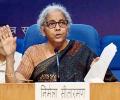
'When the government wants to sell these assets, even if one set of assets gets caught in any quagmire, the whole process will fail.' 'The entire world is watching us.'

The government also proposed promoting 'one product one district' for better marketing and export of horticulture crops. It also called on states for early implementation of three key central model laws on land leasing, agriculture produce and livestock marketing and contract farming.

Rupee volatility could be dampened if it is steadily manoeuvered to levels consistent with inflation differentials, say Jaimini Bhagwati and Abheek Barua

'If the Union Budget can provide incentives for animal spirits to come as well as induce demand stimulus and consumption, the Budget would have done a wonderful job.'

The trio, 'twin shocks' of demonetisation and GST, 'twin balance sheet' problem that has been weakening India's banking system and the 'twin deficit' problem will continue to challenge economic management and performance in the year ahead, says Shankar Acharya.
The Reserve Bank of India on Friday said the state governments' tendency to park their large cash-surplus balances in market instruments like 14-day treasury bills reflects imprudent fund management strategy that earn less return. Instead, they should use this money to reduce fiscal deficit.

A combination of farm loan debt waivers by state governments and the implementation of the pay commission award could entail some fiscal slippages and pose a risk to inflation

In fact, no other recent Union Budget has held so much significance for the Indian economy as the one to be presented in about six weeks from now, notes A K Bhattacharya.

Will Finance Minister Arun Jaitley's Budget 2016 be able to put India on a growth trajectory?
The RBI is expected to build reserves so the source of primary liquidity creation is backed by forex reserves.

Policies to address CAD has worked well believes the bank's economists.

The 'Indian story' will be badly damaged if the Modi government is not re-elected, argues investment banker Christopher Wood.

'Will Mr Jaitley listen, or is that expecting too much in pre-election season?' asks T N Ninan.
Satyam founder Ramalinga Raju was honest at least about his dishonest dealings, with CBI finding that balance sheets were inflated by Rs 5,020 crore (Rs 50.20 billion) almost the same amount disclosed by the former IT posterboy.
The windfall from RBI may be used to trim borrowing, help fund Rs 3.3 lakh crore capex plan, capitalise banks and provide fiscal stimulus to some stressed sectors, experts and economists said.

'Waiting for a market correction and optimising entry time in the markets will be akin to missing the woods for the trees.'
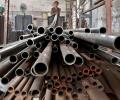
Rising prices of international coal - both coking and thermal - used in the making of ferrous and non-ferrous metals, respectively, are expected to have an impact on margins of metals companies in July-September quarter (Q2) as steel companies may see margins getting eroded, while the base firms could stand to benefit, said brokerages.

It is nearly after 13 years that a foreign brokerage has resumed holistic coverage on stocks of public sector banks (PSBs). To that extent, Morgan Stanley's report dated March 3, where the analysts have listed their order of preference for PSB stocks, is an indication that the state-owned banks may once again be attracting some interest, thanks to three back-to-back quarters of good results in FY21 so far. "State-owned banks' balance sheets have improved, and bad loans formation should moderate going forward," the analysts note and this is the key reason for them to relook at their stance on PSBs. While State Bank of India (SBI) remains their preferred pick, stocks of Bank of Baroda (BOB) and Punjab National Bank (PNB) have been upgraded from 'underweight' to 'equal-weight'. The brokerage maintains its underweight recommendation on Bank of India and Canara Bank.
'We get an overzealous army of tax inspectors pushing the economy too hard,' says Ajay Shah.
"This Budget needs to come up with measures that balance the high inflation and sustainable growth. The continuing fiscal problems and revenue deficit will force the budget to take stringent revenue making measures including looking at introducing or extending the stimulus packages to boost revenues," said G Bala Reddy, chairman and managing director, ICSA India.

S&P expects India to grow at 7.4 per cent in 2015, similar to the central bank's forecast for the fiscal year ending in March.

Inflation is on a declining trend, Eco Survey stated.

Consumers are paying an exorbitant 180 per cent tax on petrol, and 140 per cent on diesel in Delhi and in most other towns in India. Little wonder then that the central government expects a staggering Rs 3.46 trillion by levying excise duties on retail sale of the two fuels this year, and Rs 3.2 trillion the next. States would generally have had reason to cheer, as they command a 41 per cent share in Centre's tax revenues. But as the Centre has raised excise duties in the form of "cess," the revenue proceeds are by nature not shareable with states.

In his address to the nation on the eve of 73rd Republic Day, President Kovind noted that democracy, justice, liberty, equality and fraternity form the bedrock of India and stressed that the observance of Fundamental Duties mentioned in the Constitution creates the proper environment for the enjoyment of Fundamental Rights.
The wholesale price index inflation is projected at 6.4 per cent for 2017-18.

A government can't just take away public money, and the RBI can't extinguish its liability. 'The RBI has to honour the value any time a person with legal and taxed money lays claim on the value.'
In terms of stock selection, India continues to benefit from two phenomena - the big getting bigger and availability of quality stocks in relative abundance compared with its Asian peers.

Almost all infrastructure ministries continued spending on capex throughout the lockdown, even as the Centre tried to maintain some semblance of economic normalcy.

The monetary authority said it was worried on three fronts with regard to inflation as well as the economy.
